
Skull art is visual art that uses a human or animal skull, bones, or a skeletal figure as a meaningful image. It can ask viewers to think about mortality, memory, identity, rebellion, transformation, or simply the structure of a living body. A skull does not carry one fixed message: its meaning changes with the artist, period, culture, medium, accompanying symbols, and the viewer's own experience.
That flexibility helps explain why the skull keeps returning in painting, printmaking, illustration, sculpture, tattooing, clothing and popular visual culture. It is immediately recognizable, but never completely neutral. Even before an artist adds color, text, machinery, flowers or costume, the skull brings the presence of a life into an image while withholding the identity of a particular face.
Skull art is not one movement or style. It is a broad way of describing artworks in which the skull or skeleton plays an important visual or conceptual role. In one work, a skull may be a reminder that life is finite. In another, it may represent an ancestor, a warning, a character, a scientific object, a joke, a badge of defiance, or a structure that lets an artist explore shape and texture.
The most useful question is therefore not only “What does a skull mean?” but “What is this skull doing in this particular image?” The answer comes from context: who made the work, when and where it was made, what surrounds the skull, and what the artist says about it.
The skull is both familiar and strange. It supports every human face, yet most people encounter it as an image rather than as part of everyday life. Its symmetry and cavities offer a strong graphic structure. Its association with the body gives it emotional weight. Artists can preserve that weight, resist it, or turn it in a completely different direction.
Some artworks use skulls to make death visible and to focus attention on the limits of time. The European phrase memento mori—a reminder of death—is one historical framework for this use, but it is not a universal definition of all skull art. A work concerned with remembrance, grief or impermanence may look very different from one made as satire, decoration or protest.
For a closer look at how contemporary culture revisits that theme, read memento mori in contemporary art and popular culture.
A portrait records visible differences between people. A skull removes many of those social signals while retaining the architecture beneath the face. That can make it a symbol of shared physical existence, but it can also make a person anonymous. Artists use that tension to ask who is being remembered, who has been reduced to a type, and what remains when a recognizable face disappears.
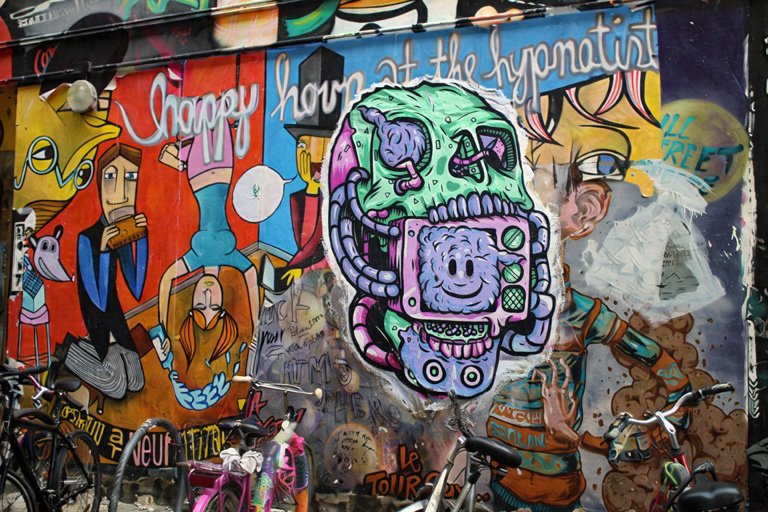
In modern visual culture, skulls can signal danger, resistance, speed, loudness or refusal. They also work as characters: smiling, mechanical, floral, cosmic or absurd. None of these meanings automatically cancels the others. An image can be playful and unsettling at the same time.
The skull's compact silhouette also makes it useful in graphic design. It remains legible when reduced, repeated or combined with other forms. That practical quality matters to illustrators and designers as much as the symbolism does.
A skull can symbolize mortality, memory, equality, danger, defiance, transformation, or another idea chosen by the artist—but no list applies to every artwork. Meaning must be read from the whole image and its setting.
Start with what accompanies it. Flowers can create a contrast between growth and decay. A machine can turn the body into a question about technology. Clothing or insignia can identify a role. Repetition can make one skull feel less like an individual and more like a pattern, crowd or system. Color can push the same form toward mourning, humor, psychedelia or advertising.
Medium changes the reading too. A skull carved into a ritual object, painted into a portrait, printed on a protest poster and drawn as a fictional character may share a silhouette while serving entirely different purposes.
Skull imagery appears in objects and artworks made in different places and periods, but those examples should not be merged into a single story about what “all cultures” believed. The historical meaning of an object depends on evidence about its makers, use and setting.
The supporting article the history of skulls in art follows several documented examples while keeping their contexts distinct. More specialized subjects belong on their own pages: skulls in tattoo history addresses the broad tattoo question, while skulls with horns in tattoo history examines that narrower visual type.
Contemporary artists inherit a long visual record, but they do not have to repeat it. A skull can become a screenprint, a digital composite, a sculptural object, a character design, a pattern, or part of an invented world. Photography, drawing, vector tools, 3D media and physical paint can all produce different kinds of evidence: a hand-drawn line, a repeated image, a polished surface, or the visible history of revisions.
Named artists also require their own context. A work by Georgia O'Keeffe, Andy Warhol or Jean-Michel Basquiat cannot be explained simply by calling it “skull art.” The artist's wider practice, the date, the medium and the specific work matter. For one focused example, see Basquiat's skull imagery and Untitled.
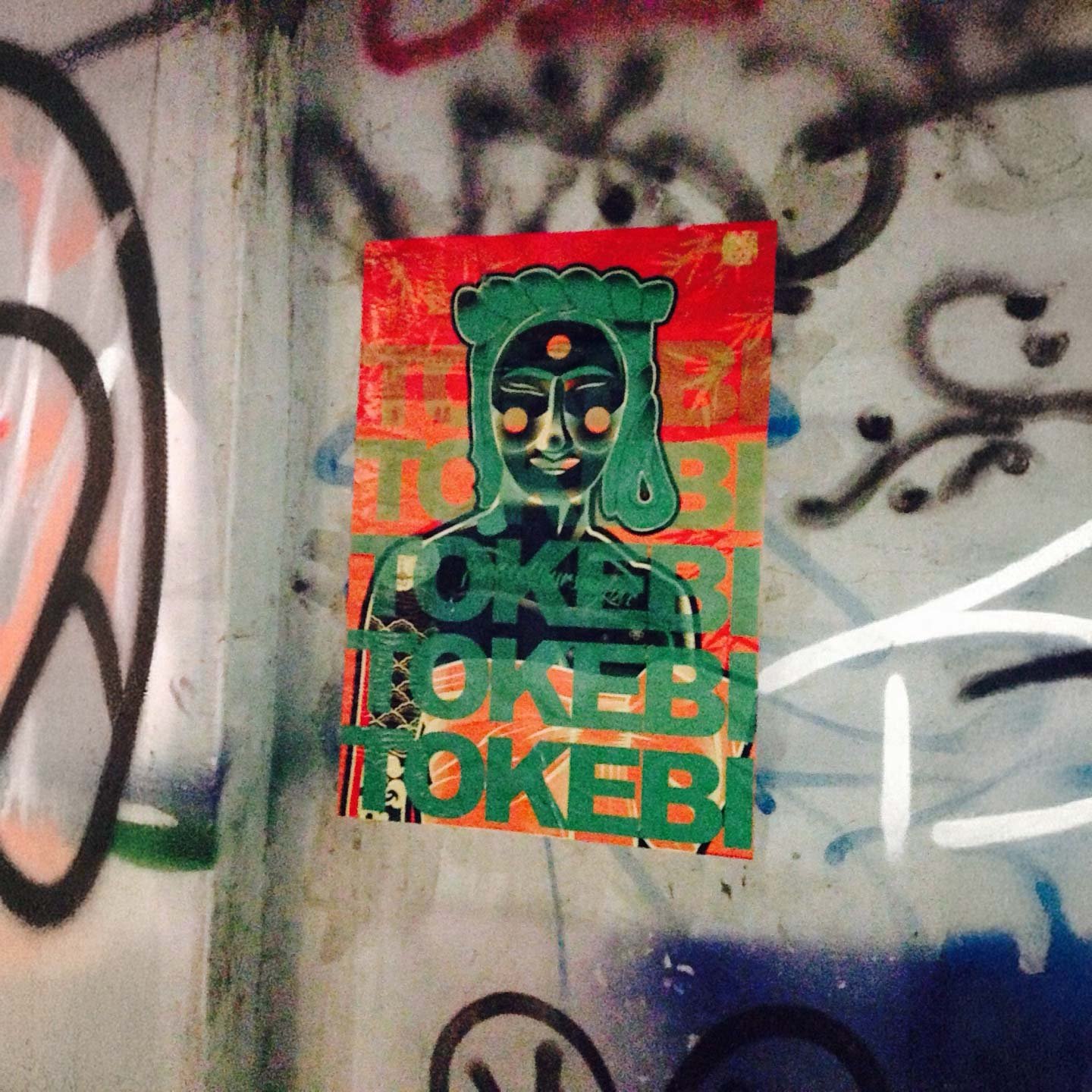
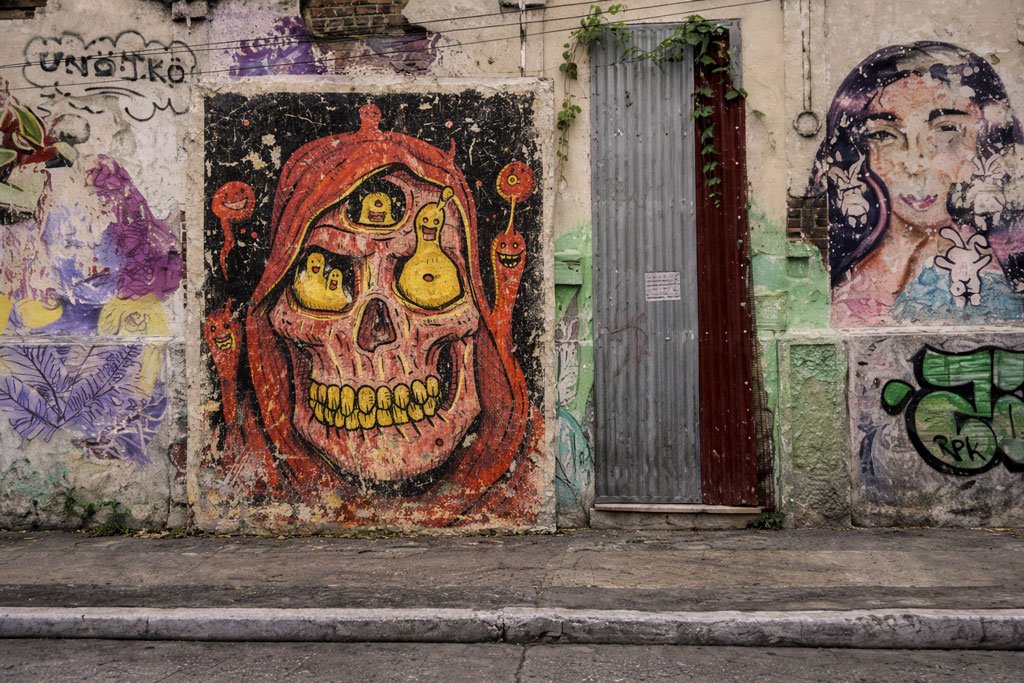
Tokebi is the artistic identity of Bernal Aguilar, a Guatemalan visual artist and illustrator. Skull imagery became central to his practice because it gave him a recognizable structure he could repeatedly alter. The subject could survive collage, imperfect drawing, crosshatching, color shifts and unexpected combinations while still reading as a skull.
Bernal recalls encountering imported music, video games, comics, television and other popular imagery early, before he had a vocabulary for thinking of those images as artistic influences. Catholic school placed a very different symbolic system beside them: God, judgment, hell, sin, morality and religious imagery. Neither world replaced the other. The contradiction between doctrine and institutional rules on one side, and monsters, machines, fantasy, violence and global popular culture on the other, became part of the visual material he absorbed.
His early drawings of horned skulls, fangs, skeletal creatures, bone wings and imagined hellish environments emerged inside that collision. Heavy music or a game such as Mortal Kombat can be examples of the larger environment, but no single commercial property explains the work.
From 2003 through 2008, while living in Chicago, Bernal became interested in designer-made T-shirt communities such as Threadless and Design By Humans. He wanted people to wear his skull ideas and also wanted design to generate income. The skulls came before Chicago; this period produced their first major stylistic transformation.
His background was closer to graphic design than formal academic drawing. At the time he worked mainly in Adobe Photoshop, with some Adobe Illustrator, collage and recombination of graphic elements. Earlier demonic skulls did not fit the designer-T-shirt and hipster visual market he was studying, so the imagery began to mutate. Black, white and red remained important, while strange neon and retro palettes—remembered in relation to 1970s comics and black-light imagery—entered the work.
Living abroad often meant limited money, small rooms and little conventional studio space, so digital production was practical as well as visual. The repeated motif became a testing ground: one skull could be broken into collage; another could be crossed with machinery, retro science-fiction or a recovered artifact. Reuse was a way to see how far the structure could be pushed before it became a new character or object.
Bernal's digital process begins with pen or pencil, moves into vector inking in Adobe Fresco, and continues with color in Adobe Photoshop. The stages keep drawing at the center while allowing lines, fragments and colors to be recombined.
His physical process begins with pencil, followed by technical pen, acrylic and acrylic markers. Each material leaves a different kind of edge: provisional construction, controlled ink, painted mass and sharper surface detail.
Tokebi's approved visual language is summarized by the phrase “Purveyor of cosmic psychedelic skulls.” The work combines skull forms with saturated color, retro science-fiction, collage, machines, relics and strange biological or ritual-looking objects. The aim is not polished corporate futurism. It is a personal world of used, repaired and mismatched forms—something discovered, altered and put back into circulation.
Read how Bernal Aguilar develops Tokebi's skull imagery for the studio-focused story.
Some Tokebi skull imagery developed beyond a repeated motif and began to suggest artifacts, travelers, cultures and beings from an unfinished fictional setting. Bernal's interests in anthropology, archaeology and cosmology helped the images expand from individual skulls toward material remains, machines, imagined civilizations and planetary settings. In the approved Tokebi canon, the Skulloids are an alien civilization of skull-like beings.
That fiction has a clear boundary. Tokebi is Bernal Aguilar's artistic identity, not a Skulloid or a character inside the story. Not every artwork or product is automatically canon. A piece enters the Tokebi Universe only through deliberate human approval.
Different questions deserve different destinations:
The skull is useful because it can hold different ideas without becoming a single fixed message. For Bernal, it became both a recurring artistic structure and a way into a larger visual world.
You can learn more about Bernal Aguilar and Tokebi, continue with the Tokebi skull-artist studio feature, or explore Tokebi artwork and wearable art. The shop is a continuation of the imagery, not a substitute for the context behind it.