

The Harley-Davidson skull logo is called the Willie G. Skull. Willie G. Davidson created the graphic, and it first appeared on T-shirts for the 2000 Daytona Rally before Harley-Davidson used it on more apparel, parts and accessories. It is not the same as the Bar & Shield, Harley-Davidson’s older and primary brand emblem, and it should not be confused with every skull or winged-skull design seen in motorcycle culture.
The Willie G. Skull is a front-facing skull set inside a circular treatment with “Harley-Davidson Motorcycles” around it. Its bold symmetry and limited detail make it easy to recognize on a motorcycle part, jacket, patch or T-shirt.
Harley-Davidson credits the design to Willie G. Davidson, the grandson of company co-founder William A. Davidson and a longtime design leader at the company. According to Harley-Davidson’s own product history, Willie G. regularly created graphics for Daytona Bike Week merchandise. The skull graphic first appeared on 2000 Daytona Rally T-shirts and later expanded into Harley-Davidson apparel, parts and accessories.
That documented origin matters. The Willie G. Skull is an official Harley-Davidson graphic with a specific designer and debut. It is not a name for biker skull art in general.
The key date is 2000. Harley-Davidson identifies the 2000 Daytona Rally T-shirts as the graphic’s first appearance.
This corrects a common source of confusion. The Willie G. Skull is much newer than Harley-Davidson itself, which was founded in 1903, and much newer than the Bar & Shield. It belongs to the company’s modern design history rather than its earliest years.
The logo’s later use on merchandise and motorcycle components helped it become familiar beyond the original rally shirt. Repetition across different objects gave it the quality of a rider emblem: something that could identify an affiliation or attitude at a glance.
The two graphics belong to Harley-Davidson, but they have different histories and roles.
The Bar & Shield is Harley-Davidson’s historic core mark. The Harley-Davidson Archives document an early example on the back cover of a 1910 motorcycle catalog, and the company filed an official trademark application on July 19, 1910.
The Archives also make an important limitation clear: surviving company records do not confirm who designed the original mark or what inspired it. Claims that assign the early logo to a particular designer should therefore be treated cautiously unless new primary evidence appears.
The Willie G. Skull has a documented creator and a documented debut: Willie G. Davidson and the 2000 Daytona Rally T-shirts. It became a popular graphic for merchandise and parts, but it did not replace the Bar & Shield as the company’s principal historical emblem.
The simplest distinction is this:
No. A skull with wings should not automatically be labeled the Willie G. Skull.
Page 9 of the Winter 2014 Canada edition of H.O.G. Magazine presented a separate “Skull with Wings” design as a merchandise graphic. Its name and form distinguish it from the circular, front-facing Willie G. Skull. Harley-Davidson and its related programs have used more than one skull-based graphic, so the designs should be identified by their documented names rather than grouped together.
The same caution applies to skulls seen on jackets, club patches, tattoo flash, custom tanks and aftermarket products. Skull-and-crossbones, winged skulls and other biker skull designs are part of a much wider visual tradition. Resemblance alone does not make one of those images an official Harley-Davidson mark or a Willie G. Skull.
A skull does not have one universal meaning. Its meaning changes with its setting, audience and treatment. In motorcycle culture, it can suggest an awareness of risk, independence, endurance, mortality or transformation. Those are cultural readings, not an official explanation of Harley-Davidson’s intent.
The image also works for practical graphic reasons. A skull has a strong silhouette, near-bilateral symmetry and features that remain recognizable after simplification. It can be reproduced on a small metal component, embroidered patch, fuel tank, poster or shirt without losing its identity.
That combination of symbolism and utility helps explain why skulls recur across motorcycles, tattooing, lowbrow art and heavy music. Each scene can adapt the form to its own voice. For a broader look at that history, see The Enduring Allure of Skulls in Art.
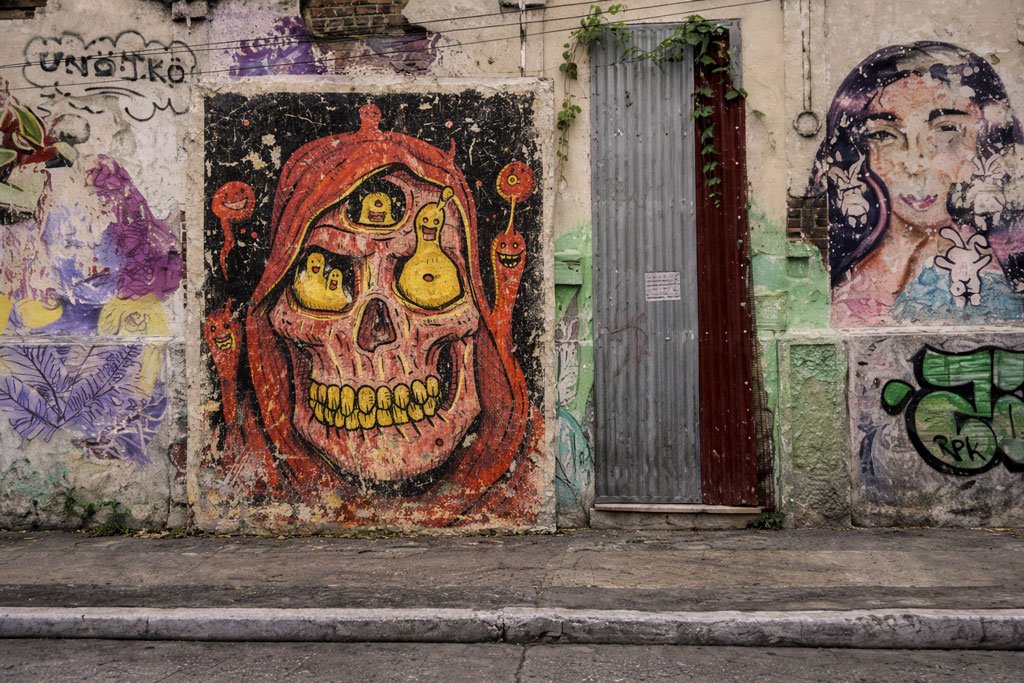
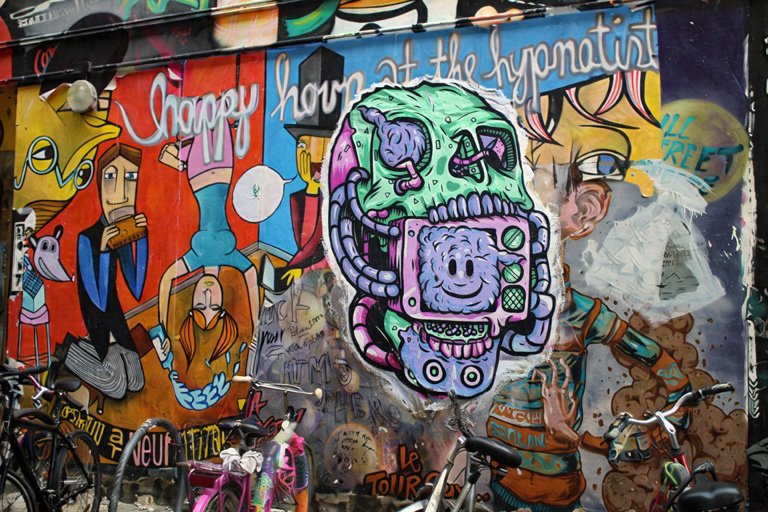
As an artist who repeatedly works with skull iconography, I see the skull as a visual framework rather than a finished idea. Its familiar structure gives viewers an immediate point of entry, while changes in expression, ornament, color and surrounding symbols create a new identity.
Motorcycle and music cultures use graphics in similar ways. A successful image must read from a distance, reproduce across several formats and give a community something recognizable to gather around. On a motorcycle it may appear on a tank or part; for a band it may move between a poster, album cover, stage backdrop and merchandise.
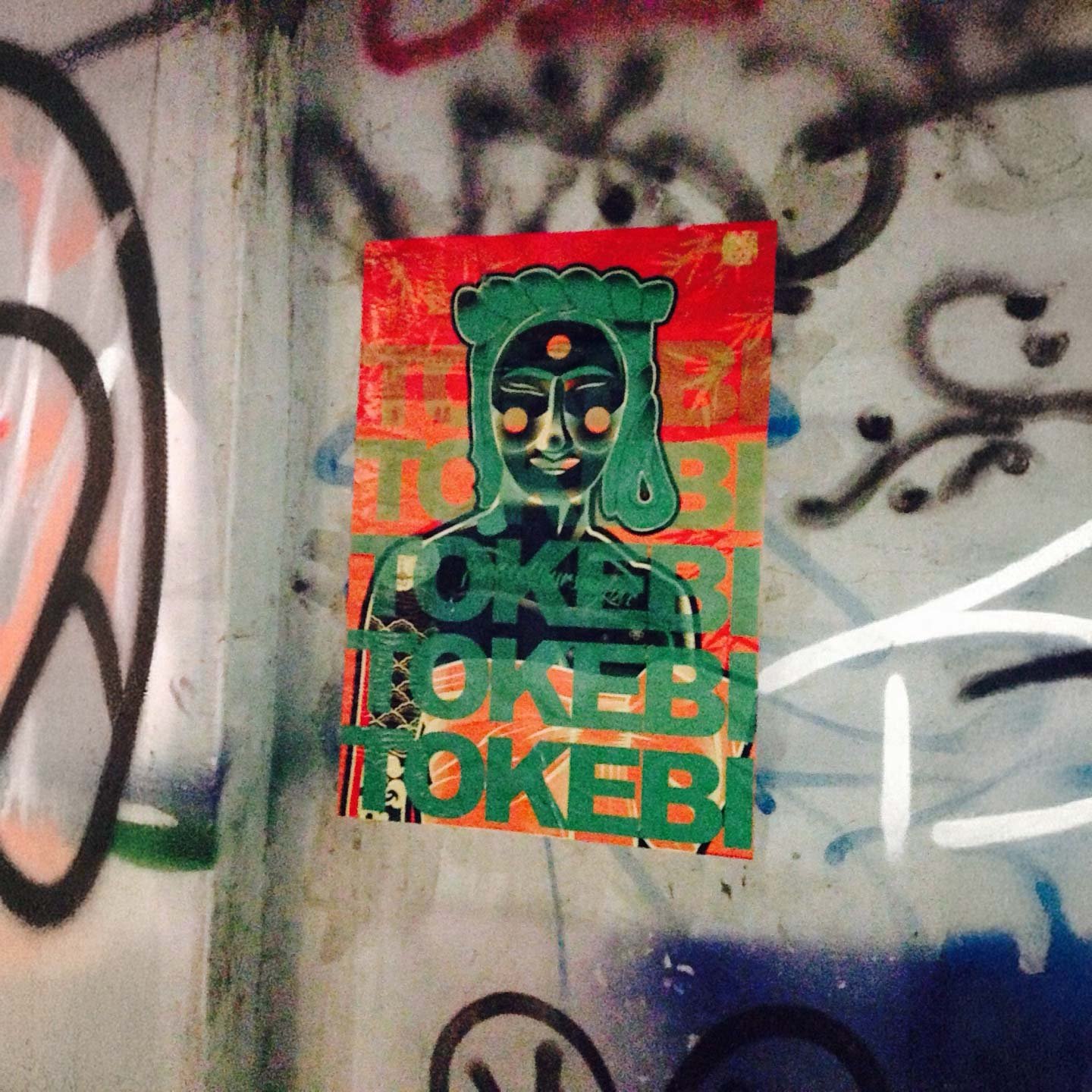
My own work as TOKEBI combines skull imagery with lowbrow art, psychedelia and Guatemalan visual influences. My experience includes posters for Seoul’s underground music scene and official artwork for Mastodon’s 2019 European tour. That work reinforced a basic design lesson: a skull becomes memorable through the specific world built around it, not through the symbol alone.
For artists, that distinction also matters legally and creatively. Studying how an emblem achieves clarity is different from copying a protected logo. Original work should develop its own composition, lettering and surrounding elements instead of reproducing Harley-Davidson’s trademarks.
Explore TOKEBI’s skull prints and skull apparel, or contact TOKEBI about commissioned album, poster or brand artwork.
This independent editorial article is not affiliated with or endorsed by Harley-Davidson. Harley-Davidson, H-D and Bar & Shield are trademarks of Harley-Davidson Motor Company. Product and company names are used only for identification and commentary.