What Are Art Districts and Why They Matter for Artists
Over the last century, art districts have emerged as some of the most influential structures in the cultural economy. Often reduced to tourist attractions or clusters of murals and galleries, art districts in reality function as visibility engines, places where artistic work gains meaning, circulation, and relevance through social proximity. For emerging artists seeking recognition, understanding how art districts work is as important as developing a distinctive visual language.
Art history repeatedly demonstrates that artistic relevance does not arise in isolation. It emerges where people, ideas, and attention converge. Art districts are the physical and symbolic manifestation of that convergence.
What an art district really is
An art district is not defined by geography alone. It is defined by density, of artists, cultural workers, curators, collectors, photographers, writers, brands, and audiences interacting in a shared space. These interactions create constant feedback loops: artworks are seen, discussed, documented, shared, and reinterpreted.
In practical terms, an art district combines several elements:
- A critical mass of creative production
- Public or semi-public visibility (streets, studios, pop-ups, galleries)
- Social circulation (events, openings, informal gatherings)
- Narrative coherence (the area is known for something culturally specific)
This combination transforms individual artworks into part of a broader cultural signal. Artists operating within these zones benefit not only from exposure, but from contextual validation.
Art districts as recognition systems
From a career perspective, art districts matter because they operate as legibility systems. They make artists readable to the outside world. Curators, journalists, collectors, and digital audiences often use districts as shortcuts for relevance: if something is happening there, it is assumed to matter.
This mirrors what sociological research has shown about artistic fame: recognition tends to follow network position, not just originality. Art districts concentrate networks in physical form. Presence, whether direct or indirect, places an artist inside an ongoing conversation. Importantly, this does not require permanent residence. Historically, many artists associated with influential districts were temporary participants, frequent visitors, or collaborators whose work circulated socially even when they were not physically present.
The most influential art districts globally
While every city has its own creative geography, certain art districts have achieved global symbolic power because they combine local authenticity with international reach.
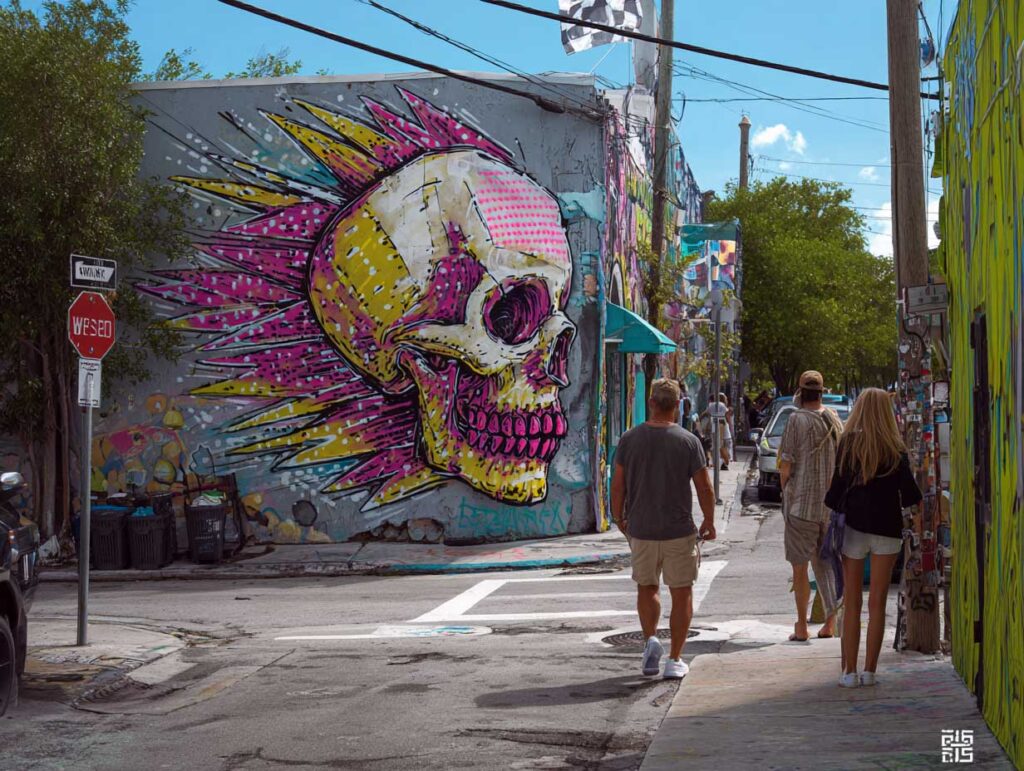
One of the most cited examples is Wynwood. Its transformation from an industrial warehouse zone into a global reference for street art and contemporary aesthetics demonstrates how urban art, branding, festivals, and social media can align into a single cultural ecosystem. Wynwood’s importance lies not only in its murals, but in its role as a meeting point for artists, brands, collectors, and global audiences during major cultural events.
In New York, SoHo historically played a similar role, especially during the late 20th century. Former industrial lofts became studios and exhibition spaces, attracting artists whose work blurred the boundaries between fine art, design, and conceptual practice. Later, Bushwick emerged as a contemporary counterpart, driven by street art, grassroots galleries, and digital-native artists.
In London, Shoreditch became synonymous with experimental art, fashion, and urban culture. Its relevance came not from institutional validation, but from its ability to generate constant visual output that traveled globally through photography and online platforms.
Berlin’s Kreuzberg represents another model: politically charged, interdisciplinary, and internationally connected. Its power lies in cultural hybridity and openness rather than commercial polish.
Across these examples, the pattern is consistent. Art districts succeed when they combine:
- Visual density
- Cultural narrative
- Social openness
- International permeability
Why art districts amplify artists
Art districts reduce friction between creation and recognition. Instead of an artist having to individually reach curators, audiences, or platforms, the district itself acts as a multiplier. Work produced or shown within these zones is more likely to be photographed, shared, referenced, and contextualized.
This amplification operates on several levels:
- Social: artists meet other artists, collaborators, and cultural intermediaries
- Symbolic: association with the district confers cultural legitimacy
- Digital: content generated in recognizable districts circulates more easily online
In other words, art districts externalize part of the visibility labor that artists otherwise have to perform alone.
The relationship between art districts and social media
In the contemporary landscape, art districts and social media are structurally linked. Districts generate constant visual material; platforms distribute it. Murals, installations, and events are designed, implicitly or explicitly, to be documented and shared.
For artists, this means that visibility is no longer limited to local audiences. A work produced within, or conceptually tied to, an art district can reach global viewers within hours. This is why many artists build recognition without living full-time in these areas: they participate in the symbolic economy of the district through content, collaborations, and discourse.
Crucially, successful artists use social media not as a portfolio, but as a network mirror, showing presence, interaction, and contextual awareness rather than isolated finished pieces.
Art districts as cultural myths
Beyond their functional role, art districts operate as cultural myths. They represent ideas: freedom, experimentation, rebellion, relevance. Associating with them is less about address and more about narrative alignment. This explains why artists across the world reference certain districts in their work, writing, or visual language even when they are geographically distant. Cultural proximity increasingly matters more than physical proximity. From a branding and recognition standpoint, being perceived as part of an ecosystem can be as powerful as actually inhabiting it.
What this means for emerging artists
For artists seeking recognition today, the lesson is not that one must relocate to an art district at all costs. The lesson is that visibility is collective, and art districts are one of the most efficient collective structures ever developed for cultural circulation.
Understanding how they function allows artists to:
- Position their work within broader conversations
- Build networks intentionally rather than randomly
- Leverage social media as extension, not replacement, of real ecosystems
- Create contextual relevance around their practice
As history and research consistently show, recognition follows connection. Art districts simply make those connections visible.
Written by TOKEBI, an independent visual artist exploring urban aesthetics and contemporary mythologies.”
SHARE IT:
LATEST ARTICLES