
Street culture is built on visibility, memory, and shared codes. Unlike institutional art, which often relies on context provided by galleries or texts, street art must communicate instantly. Walls, streets, and public spaces do not offer long attention spans. As a result, repetition and symbols became fundamental tools in street culture, allowing artists to transmit identity, values, and presence with immediacy and clarity.
This article explores how repetition functions as a cultural strategy, why symbols play a central role in street and pop art, and how motifs such as skulls became enduring elements of contemporary urban visual language.
Repetition as Recognition
In street culture, repetition is not redundancy; it is recognition. Repeated symbols, characters, or visual patterns allow an artist’s work to be identified quickly, even when encountered briefly or from a distance. A repeated image acts as a signature, replacing the need for written authorship.
This practice emerged naturally in graffiti culture, where artists repeated tags, throw-ups, and characters across neighborhoods. The more frequently a symbol appeared, the stronger its association with the artist. Over time, repetition created reputation. Visibility equaled existence.
In contemporary street art, this logic persists. Artists who repeat motifs build visual continuity across cities, platforms, and mediums. The audience learns to recognize the symbol before knowing the name.

Symbols as a Shared Language
Symbols function as compressed meaning. They allow complex ideas to be communicated without explanation. In street culture, symbols must be legible across social, linguistic, and cultural boundaries. This requirement favors archetypes; faces, eyes, hands, animals, and especially skulls.
A successful symbol in street art is flexible. It can be humorous, aggressive, political, or poetic depending on context. This adaptability is why symbols endure while styles evolve. Street culture does not preserve aesthetics; it preserves icons.
As discussed in the article How Urban Art Became a Global Cultural Language, shared visual symbols enabled street art to move beyond local scenes and become internationally intelligible. Repetition reinforces this global readability.
Repetition Creates Meaning Over Time
A single symbol may attract attention; repeated symbols create meaning. In street culture, repetition across walls, cities, and digital platforms builds narrative even without explicit storytelling. The audience begins to associate emotions, attitudes, and values with the repeated image.
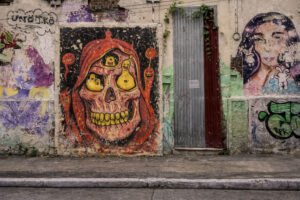
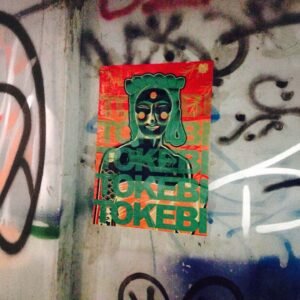
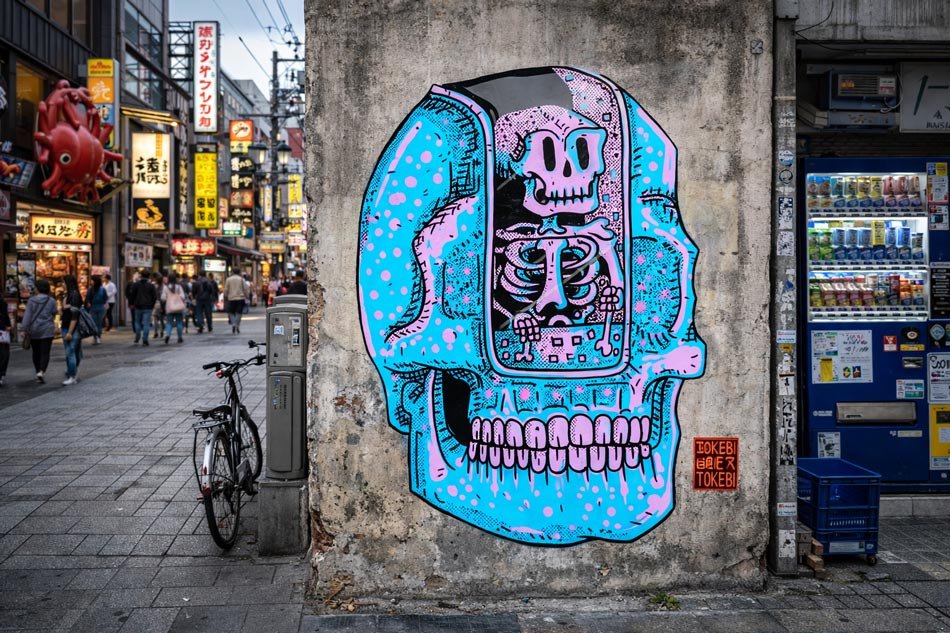
This process mirrors branding but operates outside commercial frameworks. Instead of selling products, repetition in street art builds cultural presence. The symbol becomes a carrier of identity. Over time, repetition transforms anonymous imagery into authorship. This is one reason why many street artists resist constant stylistic reinvention. Consistency strengthens memory, and memory strengthens relevance. A clear example of symbolic repetition can be seen in the work of TOKEBI (Bernal Aguilar), whose visual language consistently incorporates skull imagery across mediums. Rather than using skulls as literal representations of death, the symbol is reworked through color, expression, and context.
Through repetition, the skull becomes more than an image; it becomes a recognizable marker of authorship. The viewer does not need explanation to associate the symbol with a particular visual universe. This demonstrates how repetition transforms a universal motif into a personal language.
Importantly, this approach reflects a broader principle in street culture. Symbols do not lose power through reuse; they gain it. Each appearance reinforces familiarity while allowing subtle variation.
Street Culture, Memory, and Public Space
Public space is transient. Murals are painted over, walls are demolished, and cities change. Repetition counters this impermanence. When a symbol appears repeatedly, its memory survives even if individual works disappear.
This relationship between repetition and disappearance is central to street culture. Artists understand that visibility is temporary, so they multiply presence. The symbol becomes resilient through recurrence.
Digital platforms amplified this process. Street works documented and shared online extend repetition beyond physical space. The same symbol appears on walls, screens, and products, reinforcing recognition across contexts.
Symbols, Authority, and Cultural Weight
Symbols gain authority when they persist. In street culture, authority is not granted by institutions but earned through endurance. A symbol that remains visible over years accumulates cultural weight. It becomes part of the visual environment rather than an interruption. This authority explains why certain motifs, such as skulls, continue to dominate street and pop art. They are not trends; they are structural elements of visual culture. Artists who understand this use symbols deliberately rather than decoratively.
Repetition and symbols are the foundation of street culture’s visual power. They enable instant recognition, cross-cultural communication, and long-term relevance. Motifs like skulls endure because they operate at the intersection of universality and personal interpretation. By repeating symbols consistently, street artists transform public space into a living archive of identity. As explored in discussions on urban art as a global cultural language and contemporary approaches to memento mori, repetition is not limitation; it is continuity.
In street culture, symbols do not explain themselves. They appear, persist, and remain. That persistence is their meaning.
Written by TOKEBI, an independent visual artist exploring urban aesthetics and contemporary mythologies.