How Artists Really Become Visible: Why Networks, Not Just Originality, Drive Recognition
For decades, the dominant narrative in the art world has been romantic and reassuring: make something radically original, and recognition will follow. While originality remains essential, recent academic research and historical analysis strongly suggest that it is not the primary driver of artistic fame. Instead, visibility, networks, and social positioning play a decisive role in determining which artists gain traction, enter the canon, or become culturally relevant.
A pivotal study by Paul Ingram and Mitali Banerjee “Drawing from data behind MoMA’s exhibition Inventing Abstraction: 1910–1925“, demonstrated that artists did not become famous because their work was more innovative, but because they were better connected. The most successful artists were embedded in diverse, international social networks that extended far beyond their immediate creative circles.
This insight is not merely historical. It has direct implications for emerging artists today; especially those navigating contemporary art districts, digital platforms, and attention-based economies.
Fame Is a Social Outcome, Not a Purely Artistic One
In the MoMA study, artists’ creativity was evaluated through two rigorous methods: machine-learning analysis comparing their work to 19th-century representational art, and qualitative ratings from art historians. Surprisingly, neither measure correlated strongly with fame. Instead, the strongest predictor of recognition was the artist’s social network—particularly its diversity across geography, disciplines, and institutions.
Figures such as Wassily Kandinsky and Pablo Picasso were not simply innovators; they were central nodes in dense networks of artists, writers, collectors, patrons, and intellectuals. Their work circulated because they circulated. This reframes fame as a structural phenomenon. Artists do not become visible in isolation. They become visible because their work is continuously activated, referenced, shared, and contextualized by others.
Why Diverse Networks Matter More Than Tight Cliques
One of the most important findings of the research was that artists with international and cross-disciplinary networks outperformed those embedded in insular groups. Being surrounded only by peers who think, create, and circulate in the same way limits reach—even if those peers are influential.
This explains historical contrasts such as the difference between Suzanne Duchamp and Vanessa Bell. Both were creative, well-positioned, and connected to famous figures. However, Bell’s network extended into literature, theater, patronage, and international circles, while Duchamp’s remained confined to a single avant-garde group. Bell achieved greater historical visibility as a result.
The lesson for emerging artists is clear: depth of connection matters, but breadth matters more.
Art Districts like Wynwood, Visibility, and the Contemporary Art Ecosystem
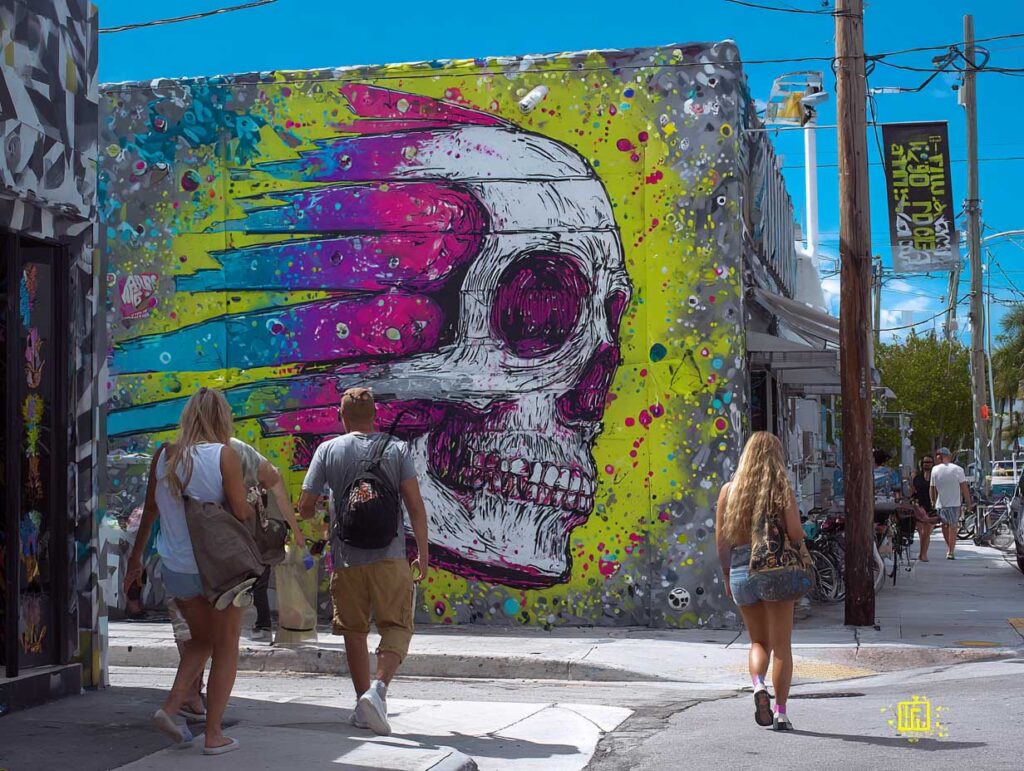
Modern art districts, whether in Miami, Berlin, Mexico City, or Seoul, function as visibility engines. Their value lies not only in murals or galleries, but in density: artists, photographers, curators, musicians, designers, brands, and tourists interacting in the same symbolic space. What makes these districts powerful is not the quality of any single artwork, but the volume of social interactions happening around aesthetics. Attention flows where people congregate, document, and share. Emerging artists often misinterpret this and focus exclusively on producing better work, while neglecting the systems that allow work to circulate. In practice, recognition comes from being present where conversations happen, both physically and digitally.
Social Media as a Network Amplifier (Not a Portfolio)
Social platforms are often treated as digital portfolios. This is a strategic mistake. Platforms such as Instagram, TikTok, and X are not archives; they are network accelerators.
Artists who gain traction typically use social media to do three things consistently:
- Signal participation in a broader scene
Posting only finished artworks isolates the artist. Posting process, studio visits, collaborations, exhibition attendance, and references situates the artist within a living ecosystem. - Cross-pollinate audiences
Collaborations, reposts, shared projects, and mutual visibility expand reach laterally rather than vertically. This mirrors historical patterns seen in avant-garde movements. - Embed narrative, not just aesthetics
Work becomes memorable when it is attached to story, context, or identity. This was true for Andy Warhol, whose work was inseparable from his social presence and entourage, and it remains true today.
Algorithms reward interaction, not excellence. Recognition follows circulation.
The Role of Cultural Translation
Artists who operate between worlds, geographic, cultural, or stylistic often gain disproportionate visibility. In the MoMA study, having contacts across countries was the strongest predictor of fame. Today, this translates into artists who can move between subcultures: street and gallery, digital and physical, local and global. Those who translate visual language across contexts become reference points, not just producers. This is particularly relevant for artists working in hybrid aesthetics: urban art, digital illustration, wearable art, or experimental design, where boundaries between disciplines are already porous.
Strategy for Emerging Artists Seeking Traction
Recognition should be approached strategically, not passively. Based on historical evidence and contemporary dynamics, emerging artists should focus on the following:
- Build relationships intentionally, not opportunistically
- Participate in scenes before attempting to lead them
- Share context as much as output
- Connect across disciplines, not just within art
- Treat visibility as an ongoing practice, not a breakthrough moment
Originality remains necessary, but it is insufficient on its own. Without circulation, originality remains invisible.
Why This Matters Now More Than Ever
The contemporary art world operates under extreme attention scarcity. Thousands of highly skilled artists compete for limited cultural bandwidth. In this environment, the myth of “being discovered” is increasingly outdated. Recognition is constructed through networks, repetition, and relevance. This does not diminish artistic integrity; it reframes it within reality.
As Paul Ingram noted, artists benefit not only creatively from diverse networks, but symbolically. Being connected makes work appear more worthy of attention, a powerful and often overlooked mechanism.
Final Reflection
History shows that artists do not rise alone. They rise with others, through others, and because of others. From early abstraction to pop art to contemporary street culture, fame has always been a collective outcome masquerading as individual genius. For emerging artists seeking traction today, the path forward is clear: cultivate relationships, embed yourself in living networks, and allow your work to move socially, not just visually.
In the long run, visibility is less about shouting louder, and more about standing in the right conversations when they happen.
Written by TOKEBI, an independent visual artist exploring urban aesthetics and contemporary mythologies.”
SHARE IT:
LATEST ARTICLES